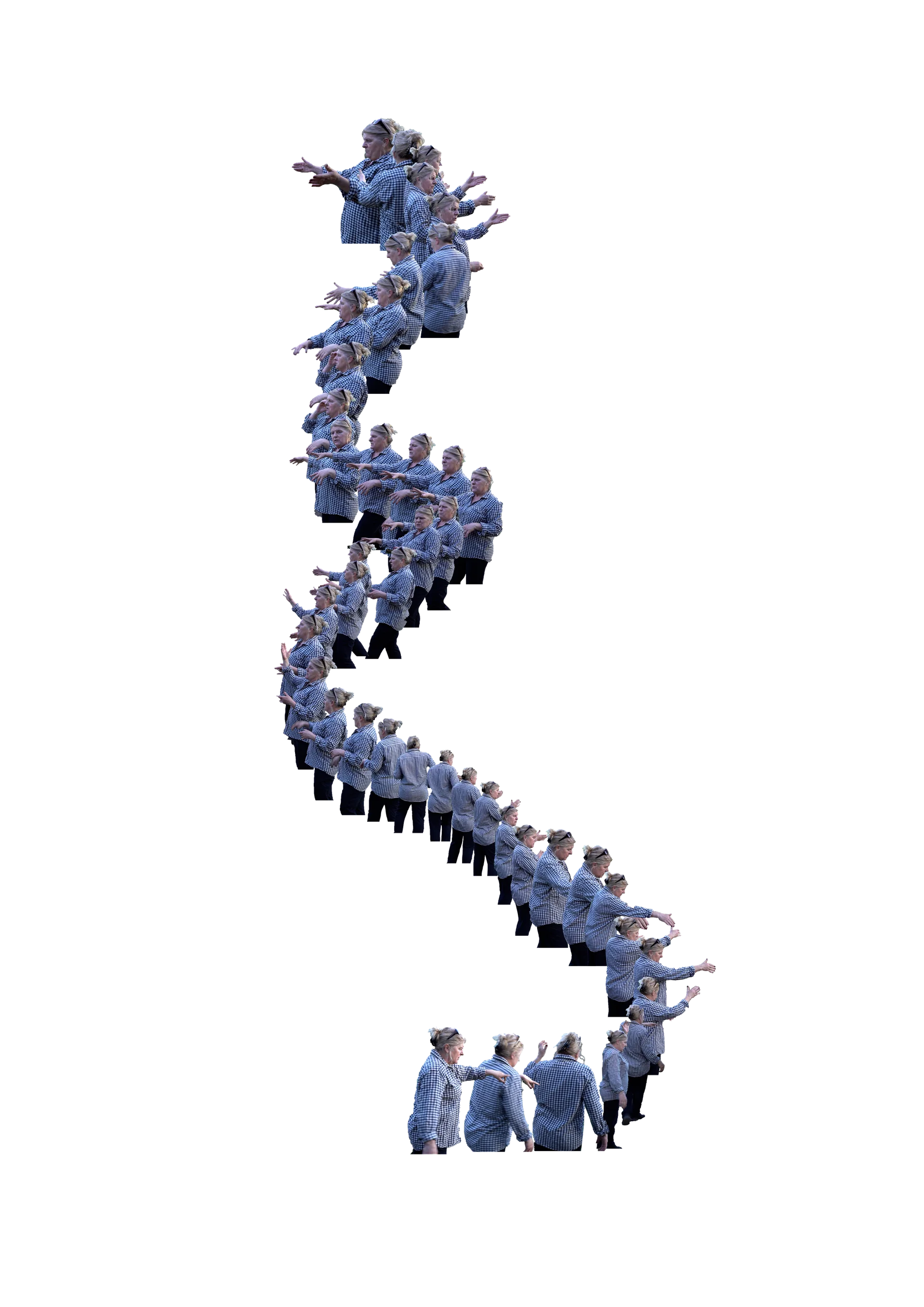
Lucyna
Slush / Ślabra
On the second day after the storm, Lucyna goes for a walk with her dogs. She chooses a route she knows by heart. That is to say, she knew it, as of today, it is unrecognisable. She records an emotional testimony:
This used to be my forest. Now there are just trees lying on the ground. I am walking my dogs, feeling a bit lost. To say I feel a bit lost is an understatement. These are the remains of my forests, which will be cut down to the stump, and there will be no forest here for many years to come. I don’t know if I will live to see the moment when it will be. Maybe Paulina and her children, my grandchildren, will live to see a forest here. The most beautiful areas, a beautiful part of the Tuchola Forest, 90% of which no longer exists. Where there used to be a huge forest, you can’t go in now. My old road is inaccessible, there are trees lying across it. The dogs run around, looking for their old trails. That’s all that’s left. I walk towards the village, where I always used to go for walks. You can see the tops of broken trees that will be cut down. Here is a young forest, which is beautiful and gives hope. And there, in the distance, are tree stumps that will all be cut down. My beloved forests. My places on earth. What remains… I can’t say for now. Everywhere I look, there are remnants of trees, and somewhere in the distance, birds. The only hope is in what is alive. There is so much deadness around. It’s terrifying. But you know what? I have three chanterelles in my pocket. I found them a moment ago. Another hope. And another hope is this barrel that’s left, which I’ve been visiting since I’ve lived here, that is, for seven years. This barrel, which wasn’t taken by anything. […] And our wonderful ślabra (eng. slush), which dogs always used to jump in and out of, and will continue to do so. There you go. Our smelly slush. Utterly beautiful.
Lucyna, Lotyń, 2025
Ślabra is the term that Lucyna and her daughter Paulina gave to a small river flowing through what used to be a forest. We found this recording while browsing through files on Lucyna’s old computer, which collapsed after the storm. Lucyna looks away—the feelings return.
At the time of the storm, Lucyna had only been living in Lotyń for seven years. From the perspective of the Forest People and other residents, she was still a stranger. But her heart was already connected to the lifeblood of this area, so at that moment, it is bleeding profusely. Lucyna wants to do everything she can to weave the bonds back into this place, the existence of which, like that of the trees, is hanging by a thread.
A Dwelling / Domowisko
From the first day after the storm, Lucyna’s dwelling is serving as a temporary shelter. Loggers and residents gather here to spend time on long post-hurricane mornings and evenings, when there is no water, electricity, access to nearby towns, mobile phone coverage, or contact with the outside world. Losses are being counted, wounds are being licked. They’re clearing up whatever they can. Gifts arrive at Lucyna’s house and are distributed among the residents. Artur, the village administrator, decides where to redirect the services to help those in need. Every evening, Lucyna met with Artur to determine the logistics for the next day. There was a lot of work to be done in the forest and around the houses. After work, everyone sat around the fire for a simple meal—usually sausages from the fire and potatoes. People came from all over Poland. Not only foresters and emergency services, but also other people willing to join the rescue operation.
Lucyna recalls that one day, someone from Bydgoszcz arrived, having bought a bucket of chanterelles from a roadside mushroom picker on the way, and prepared chanterelle sauce for everyone. How happy this made the loggers who worked hard from dawn to dusk! Chanterelle sauce! A delicacy! Such gestures mattered. Lucyna recalls both the intimacy and the unique sense of community that characterised it. They were short-lived: “When something bad happens, everyone suddenly unites. A moment later, the spell is broken and the old mess returns. People point fingers at each other, try to gain something for themselves, and conflicts arise. Who owes what to whom.” People even argued over the boxes she prepared and accused her of embezzling washing-up liquid. They used the compensation for lost belongings to buy new cars, there were even those who destroyed their own belongings in order to apply for financial support. There is no end to the discussions about who got less and who got more.
But it was necessary to help. Everyone got involved as best they could, to a greater or lesser extent. If someone did not come to Lucyna’s house to offer help, the post-storm community noticed. Such people exposed themselves to gossip and exclusion. This happened, among others, to a local dairy farmer and his wife. “It was useless to explain what it means to milk cows every day because the machines had broken down. Someone then spread rumours that they weren’t doing anything. But they spent half the day milking those cows!”
There were more situations like this—including those that “spoiled”, as Lucyna says, old customs and affected relationships. But above all, there was a sense of intimacy and people spent time together. In everyday life, this isn’t present at all. Neighbours don’t talk to each other, people barely socialise; barely greet each other from their gardens. And they never do so from behind their car windows.