Rytel Forestry
Agreement creating The Mound
That day, as usual, I arrived at the forest district office early in the morning. I already knew that things are done very early here. Foresters are early birds. Over time, I, too, began to appreciate waking at dawn, quietly putting on a coat, the sight of mist descending after the night, and the forest animals peering from the road-side. I now know almost every corner here. On the threshold, I am usually greeted by an information board, the magazine Forest Echoes, and a seasonal decoration (different depending on the time of year). Sliding doors lead to a sombre, narrow corridor. Maps or thematic boards hang on the walls: tree pests, breeding birds, endangered frog species—these are just some of the educational treasures one can read on the walls. I usually read them while waiting for a meeting.
These are not the only artefacts I have observed in this place. Initially, I noticed the faded maps behind non-anti-reflective glass and wood specimens, which particularly fascinated me when they revealed their pathologies. I ironically thought that all that was missing was a large deer antler, a stuffed fox with bared teeth, and a wolf greeting visitors at the entrance—not out of stereotype, but habit formed during visits to other district offices. For example, at the Pisz Forest District, which I visited while researching hurricanes in the “Szast” Protected Forest, a special dis-play of stuffed forest animals was created. Arranged in seemingly natural positions, they were meant to look as if they had never left the forest. A ghostly collection of bodies, which foresters called “accident animals.”
I remember my first visit to this place. I arrived there straight from the road, confused by the disappearance of mounds I had grown accustomed to. I was told that removing the mounds was an inevitable part of post-storm cleanup, which foresters are legally required to complete within five years. Soon, all of them would vanish. The thought terrified me; I felt I was losing something precious. Something we would all lose.
Just before turning into the district, I discovered that the mound near Męcikał had disappeared—the one I had recorded a few weeks earlier, the first one I had come to know and love. The ubiquitous mounds had formed the everyday landscape over the previous three years, and to me, they had always been there. I felt the need to preserve at least one. I decided that enough was enough with the disappearances. I decided to act. With flushed cheeks, I explained to the then-administrators the idea of creating a living monument—a form of commemoration that would pre-serve at least a fragment of the lost forest. I remember being met with caution at first.
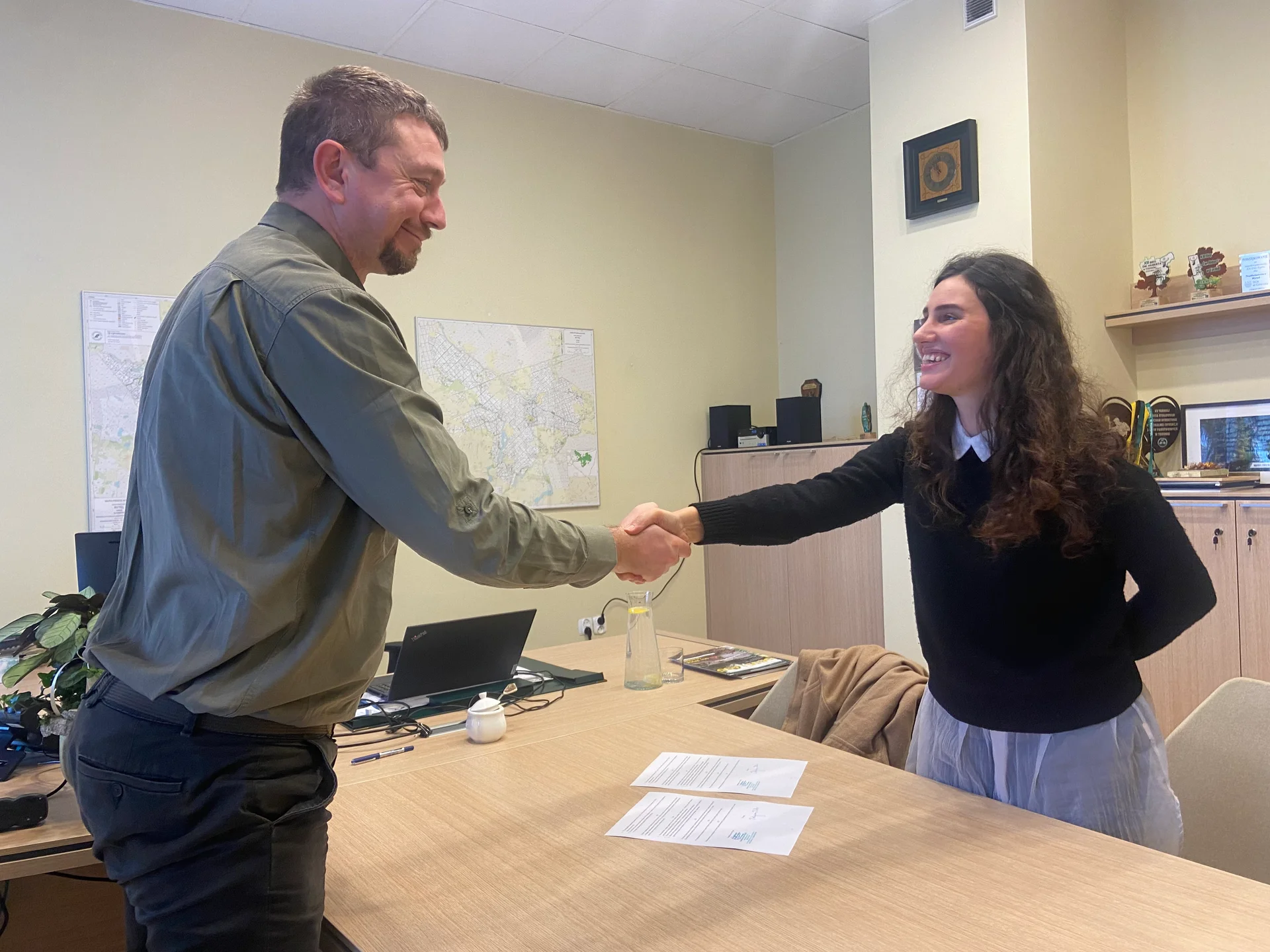
Ultimately, I received permission for the creation of the Mound-sculpture. Frequent visits to the forest district are related to formalising the transformation of the Mound into an art installation. We use the language of courtesy and diplomacy, and we prepare legal documents for our lawyers. We agree on the wording of clauses. I am particularly concerned with the installation’s continuity, so I want to include a clause stating the project’s ongoing nature. I want the Mound to be protected regardless of personnel changes. I am working with yet another team, and in such changeable, sometimes unfavourable conditions, protecting the process is important. The forest district manager expresses understanding and asks for the next round of amend-ments. Today, we will again not sign the document.
We discuss further amendments. The forest district expects me to assume responsibility. The Mound is in a public space; at any moment, it could be vandalised or set on fire. One day, a child—not necessarily playing alone, merely in the presence of a careless adult—could climb it and fall. The same could happen to a reckless adult. The danger also comes from the Mound’s instability. I have noticed parts of it being taken—mainly roots revealing resinous heartwood, likely collected by locals for kindling. We must there-fore reconsider the scope of responsibility, return to the lawyers, and then meet again.
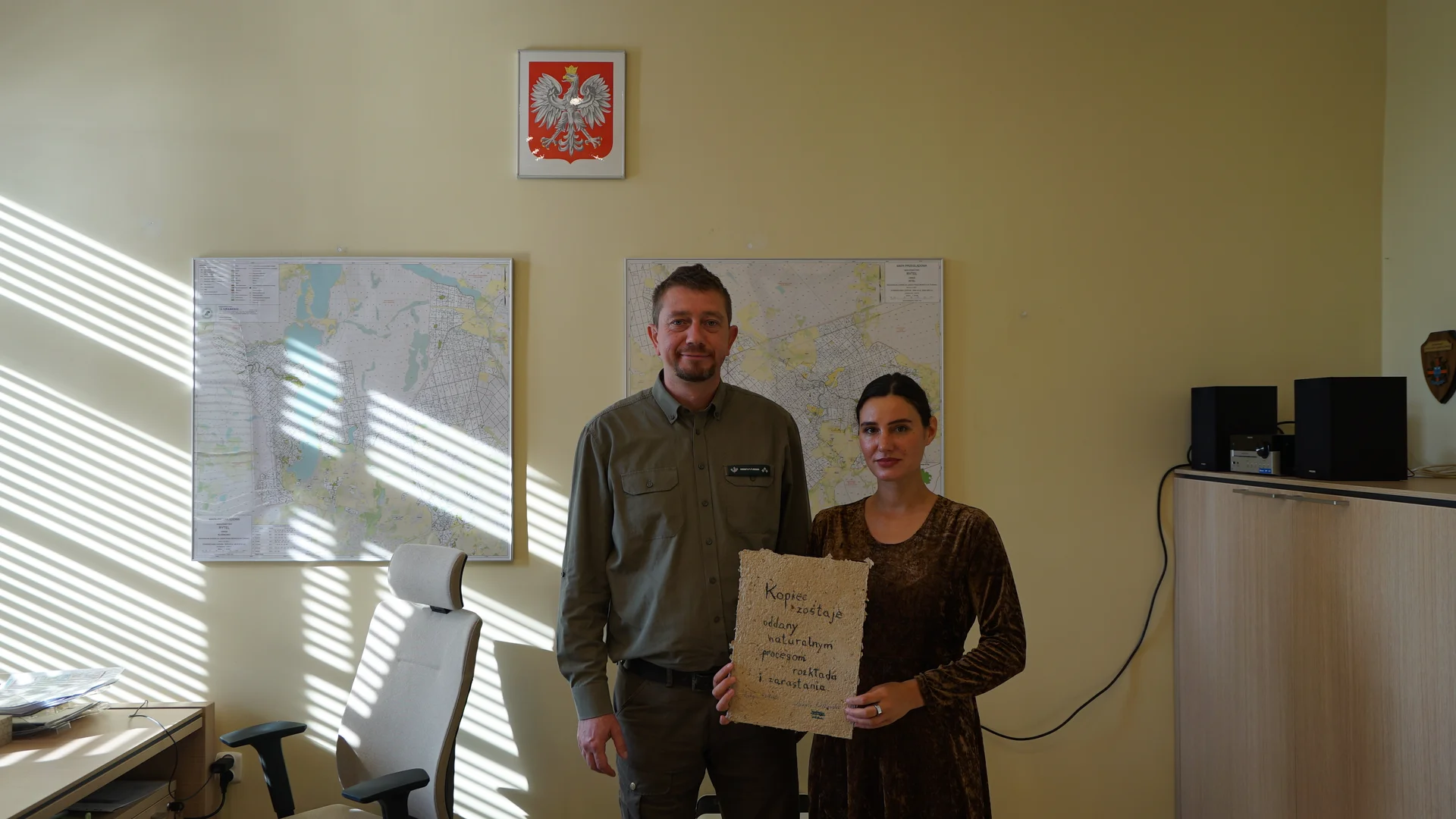
Before the end of the meeting, I take out another document, handwritten on pa-per made from plant and paper waste collected at the Lack of Forest. It contains heather and bird cherry, fibrous Rowley’s elder, some crumbled Challenger, larch needles, a handful of dried reindeer moss, St. John’s wort, raspberry leaves, and some green peat. Using a feather from a white-tailed eagle found near the mound, dipped in pigment extracted from common privet growing near my home, I wrote: “The Mound is surrendered to processes of decay and overgrowth.” This principle is important: care for a living monument should not consist of shaping it, but tending it; the mound will be shaped by natural processes. In doing so, I integrate decay, decomposition, and chaos into the ordered world of the managed forest. This is an agreement heralding the arrival of a different paradigm, a “different” forest. I show the document to the forest manager, who looks at me, perplexed. I suggestively push it toward him. “Should I sign this, yes?”. “Yes, if you agree with this statement.” The forest manager looks at the sheet for a long moment. What else could he read here? What meanings in this sentence trouble him? By signing, would he abuse his authority? Would he make a fool of himself? I can only imagine the doubts arising in the uniformed man’s mind. “Here?” he finally asks, reaching for a pen. “Yes, on the right; I’ll sign on the left. And the stamp, too.”